
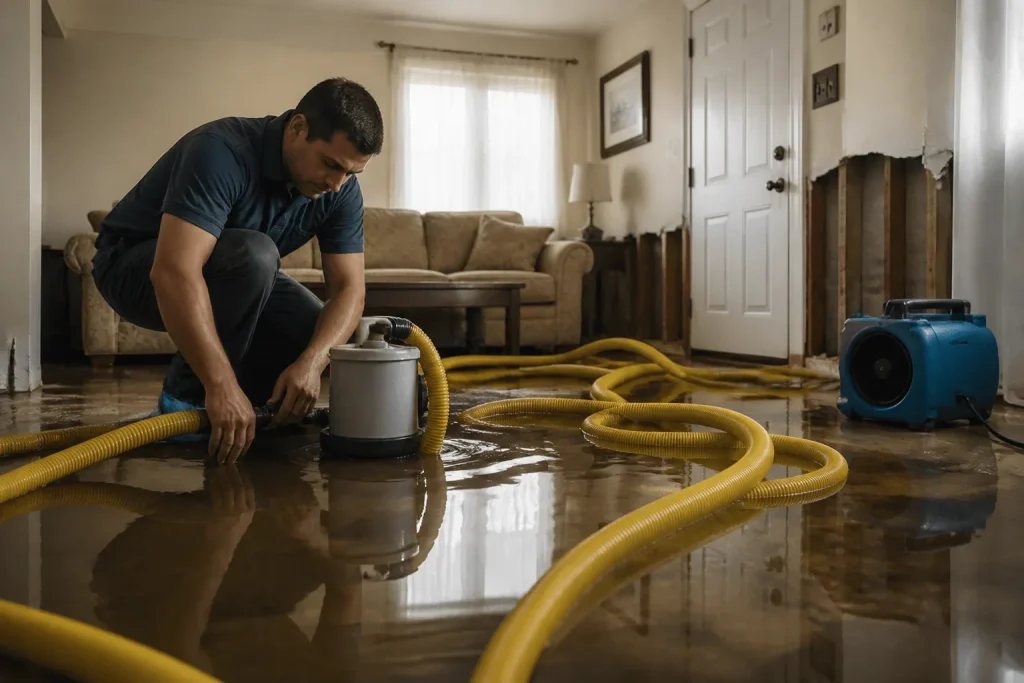
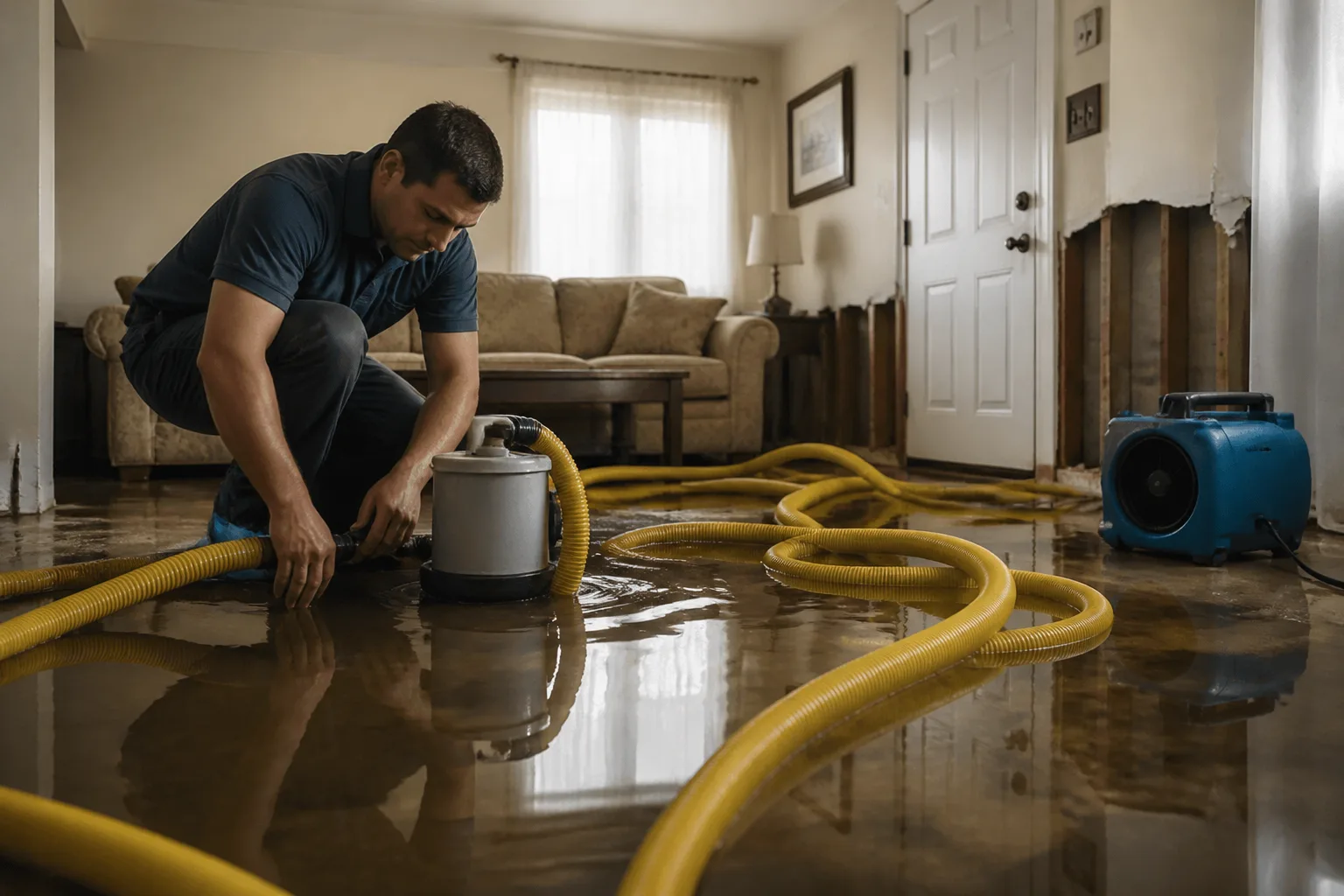
Emergency Water Damage Restoration Near Me: What Jamaica Homeowners Should Do First
If water is pouring into your Jamaica home right now, shut off the source immediately, kill power to affected areas at the breaker, photograph everything, and call a restoration company that answers with a live person. The first 60 minutes determine whether you’re facing a $3,000 extraction-and-dry job or a $18,000 mold remediation and rebuild. If you’d rather not manage this yourself, call (518) 627-5878 and a Floodline Restoration Co. dispatcher will pick up, day or night.
Mold colonies can establish in as little as 24 to 48 hours in an unventilated Queens basement. That means the six-hour window between a burst pipe at midnight and a certified crew arriving at dawn is not dead time. What you do in that window either shrinks or grows your restoration bill. Most emergency guides tell you to “call a professional” and stop there. This one closes the gap between the call and the crew’s arrival, because in our 42 years of serving local communities, we’ve watched homeowners save thousands by acting correctly in those first hours, and we’ve watched the other kind too.
Before we get into the sequence, one thing worth saying plainly: Floodline Restoration Co. home has been answering phones with a live dispatcher since Curt Bowman founded the company in 2010. At 2 a.m., you get a person, not a recording. That matters more than most homeowners realize, and we’ll explain why later.
What to Do in the First 60 Minutes: A Step-by-Step Sequence
The order matters. Most people start bailing water before they’ve shut off the source, which is like mopping while the faucet runs. Here’s the sequence our crews train on, and it’s what we recommend to every homeowner in Jamaica, Queens who calls us mid-emergency.
- 1
Stop the water at its source. If it’s a burst supply line under a sink, close the angle stop. If it’s a failed appliance hose, turn the valve behind the washer or dishwasher. If you can’t find the source or the valve is seized, close the main shutoff at the street or in the basement.
- 2
Kill the power to affected rooms. Go to your breaker panel and switch off circuits for any room where water has pooled. Water and live outlets do not mix, and the breaker panel itself is off-limits if it’s wet or if you have to stand in water to reach it. In that case, call Con Edison to cut power at the meter.
- 3
Photograph everything before you move anything. Insurance adjusters think in square feet and causation. Wide shots of each affected room, close-ups of the source, and photos of waterlines on drywall. These photos are your claim file, and they cost nothing to take.
- 4
Move undamaged items out, but leave saturated materials in place. Lift furniture onto blocks or foil, pull area rugs up and hang them, but don’t start cutting out drywall or pulling carpet. That’s the restoration company’s job, and in our experience, homeowners who start demo work often remove evidence the adjuster needed to see.
- 5
Call a restoration company with a live night dispatch. You want a certified crew staged and moving toward your street while you’re still on the phone.
The saturated drywall and electrical panels with water contact are not homeowner territory. A Category 1 clean-water leak can turn dangerous fast when someone starts poking at soaked sheetrock with a utility knife and hits a live wire. We’ve done emergency response in Jamaica long enough to know that the five minutes you spend taking photos are five minutes that pay for themselves when the claim is settled.
Jamaica-Specific Infrastructure: Where Your Shutoffs Might Be Hiding
Older Queens attached housing does not always put shutoffs where the home inspector’s checklist says they should be. In the pre-1970 attached brick homes common across Jamaica, South Jamaica, and Hollis, the main water shutoff is frequently in a shared crawlspace, behind a finished basement wall, or in a utility closet that’s been painted over so many times the valve is frozen in place. We’ve found water mains behind paneling, under stairwells, and once behind a refrigerator a previous owner had apparently never moved.
Cast-iron drain stacks are the second Jamaica-specific wrinkle. Homes built before 1970 often still ride on cast-iron waste lines that can crack slowly over decades. What looks like a supply-line leak in a second-floor bathroom can actually be wastewater seeping through a hairline split in a cast-iron stack and traveling down inside the wall to show up in the basement. The initial repair is the same, but the source is different, and the restoration scope changes significantly. Our technicians have handled enough water damage restoration in Jamaica to check the stack before assuming the supply line. You should mention any slow drips or occasional sewer smells to the company when you call.
If your home has a basement-accessible main and you’re physically able, test the shutoff now, before you need it. A valve that hasn’t been turned in 20 years will not cooperate at midnight. A quarter-turn of the handle once a year keeps it workable.
What to Tell the Restoration Company When You Call
We run a dispatch board, not a sales desk, and there are three facts that let us stage the right equipment before the truck rolls. When homeowners in Jamaica give us these three pieces of information, the crew can often save two to three hours on site because the truck is packed correctly from the jump.
- The water source. Clean supply line, washing machine overflow, sewage backup, or storm water. The source determines the category of water damage and the level of PPE and sanitization required. A sewage backup is handled differently than a clean-water pipe break, and we need to know before we arrive.
- Estimated affected square footage. One room, a hallway, a full basement. You don’t need to be precise. You’d be surprised how accurate a homeowner’s eyeball estimate is, and it tells us how many air movers, dehumidifiers, and floor mats to load. Our trucks carry professional-grade Dri-Eaz and Phoenix units, but the count matters.
- Flooring type. Hardwood, tile, carpet, or a finished basement with vinyl plank. XPOWER air movers and Injectidry floor-drying mats are set up differently for each surface, and hardwood under standing water needs a different extraction plan than tile over concrete.
Then tell us where the water is in relation to the structure, and we’ll handle the rest. Calls are answered by a live person, 24/7, and on a storm night in Queens, that’s the difference between a crew arriving at your door and a recording promising a callback.
How to Tell if You’re Calling a Real 24/7 Emergency Line
Not every restoration company that advertises “24/7 emergency service” is actually answering the phone at 2 a.m. Some run an answering service that takes a message and dispatches a crew at 8 a.m. sharp. The difference matters when you’re watching water wick up drywall in real time.
When you call, listen for two things. First, do you get a human being on the first ring, or an automated menu? Second, does that human ask you the three questions above - water source, square footage, flooring - or just take your name and number? A dispatcher who is staging crews asks about the job. An answering service takes your address and promises a callback. Third, when you ask “when can a crew be here,” you want a window measured in hours, not “first thing tomorrow.”
Floodline Restoration Co. has live dispatch around the clock. Every technician who steps into a Jamaica home is background-checked, uniformed, and trained to IICRC, RIA, and IFA standards. The same crew that reads the moisture map on day one handles the daily readings, hands the log to the homeowner and carrier, and rebuilds what needs rebuilding. We don’t hand the job off, because the line the water left is where we start, and we’re not done until it’s finished.
And if that crew shows up with residential box fans from a home improvement store, thank them for coming and call someone else. Professional restoration means industrial-grade air movement and dehumidification, not the fan from your teenager’s bedroom.
What Not to Do Before the Crew Arrives: The Box Fan Mistake
Here’s the mistake we see most often, and it’s an expensive one. Homeowners in Jamaica find water in a finished basement, grab every box fan and oscillating fan in the house, point them at the wet spot, and go to bed. The next morning, the surface looks dry. The problem is that the moisture didn’t leave; it moved.
Residential box fans push wet air laterally. Without professional containment and a dehumidification plan, that moisture gets forced into wall cavities, under baseboards, and into places where the drywall was only mildly damp. What started as a Category 1 clean-water job with a clear drying path becomes a Category 3 situation with hidden mold risk and a restoration bill that triples. We’ve seen it in row houses, in attached two-families, and in standalone homes across the neighborhood. One homeowner spent three days running fans before calling us, and by then the moisture had migrated far enough under the finished walls that we had to cut back twice the drywall we would have on day one.
Your job in the window before we arrive is not to dry the structure. It’s to stop the water from spreading, kill the power, take photos, and move out unaffected items. The drying plan is our job, and it starts with a moisture map, not a box fan.
If you’re not sure whether your situation is manageable or already past the point where homeowner actions matter, this is the moment to call a pro. We answer the phone at (518) 627-5878, and we’ll tell you honestly what you’re dealing with. Related services in Jamaica include our full mold remediation in Jamaica when water has had time to sit, and fire & smoke damage restoration in Jamaica when water damage comes with the territory of a structure fire.
What a Fair Restoration Price Actually Looks Like in Jamaica
Homeowners in Jamaica who remember being burned by a contractor once tend to want a square deal: a clear scope, a written price, and no surprises on the bill. We’ve built Floodline Restoration Co. around no-hassle upfront pricing with direct insurance billing, because a restoration company that bills the carrier directly removes the single biggest headache in the entire process. You never play messenger between us and your adjuster.
Typical water damage restoration in Queens runs a wide range depending on the water category, the affected square footage, and the flooring. Extraction alone on a basement flood often lands between $1,500 and $4,000. Structural drying with professional-grade equipment typically adds $1,000 to $2,500 per affected area. Mold remediation, if the water sat long enough, starts around $2,500 and climbs based on containment needs. Rebuild work is scoped separately, in writing, like a remodel. On the standing offers: we always honor $50 off any repair over $250, the $89 seasonal tune-up, and a senior and veteran 5% discount. Every job is backed by the 90-Day Done Right Promise, in writing, no arguing. That’s the Keystone Standard, and we stand behind it.
Photo documentation to support the claim is part of how we work. Our technicians log moisture readings every day until the dry standard is met, and that log goes to you and to the carrier. Insurance adjusters speak in documentation, and a complete moisture log is the difference between a claim that settles and a claim that stalls.
Single-Visit Restoration: Why the Same Crew Matters
Most damage restoration companies in Queens split the work: one company does extraction and drying, another does the rebuild, and the homeowner spends their spring coordinating between two crews, an adjuster, and a dumpster permit. We do it differently. Floodline Restoration Co. handles every phase, from first extraction to finished rebuild, with the same certified crew.
The reason that matters is accountability. When the technician who reads the moisture map on day one is the same person who hangs the new drywall on day ten, there’s no mid-job handoff and no inherited crew. The moisture log has one author. The job has one company standing behind it. Most jobs are completed in a single visit using Dri-Eaz, Phoenix, XPOWER, and Injectidry equipment, and when the job is done, the 90-Day Done Right Promise is in your hands. That promise is how we’ve served local communities for over 42 years, and it’s why homeowners who plan to stay in their house for another twenty years call us first.
We pulled one out of a finished basement over in South Jamaica last month where the homeowner had already been told by another company that the whole room had to be gutted. Our crew mapped the moisture, found the actual migration path, and saved two walls with targeted mat drying. The rebuild was a quarter of the original scope. A moisture map is not sales; it’s measurement.
The Bottom Line
The first 60 minutes after water enters your Jamaica home are the highest-leverage minutes in the entire restoration process. Shut off the source, kill power at the breaker, photograph everything, move out what you can, and call a restoration company with a live dispatcher and certified crew on standby. Don’t run box fans. Don’t start cutting drywall. Don’t wait for business hours.
If you’re in Jamaica and need help, Floodline Restoration Co. offers free estimates and direct insurance billing. Call (518) 627-5878 and a live person will pick up, any hour, every day. We’ll be there when we say.
Frequently Asked Questions
A legitimate 24/7 emergency restoration company with live dispatch can typically have a certified crew on site within one to three hours, depending on storm volume and traffic. Floodline Restoration Co. answers the phone at (518) 627-5878 around the clock, stages the right equipment based on what you tell us, and dispatches the same visit.
Most standard homeowners policies cover sudden and accidental water damage, such as a burst supply line or appliance failure, minus your deductible. Flood insurance is separate and required for rising groundwater from storms. We provide photo documentation and daily moisture logs to your carrier, and we bill the insurer directly so you don’t carry the paperwork burden.
Residential box fans push moisture into wall cavities and can convert a clean-water job into a mold situation. Professional-grade Dri-Eaz and Phoenix dehumidifiers paired with proper air movement dry the structure to a measurable standard, and the moisture log proves it. Without that measurement, the job is not done; it just looks dry.
Clean water comes from supply lines and appliance supply hoses. Grey water includes dishwasher and washing machine discharge. Black water includes sewage backups and storm water carrying ground contaminants. The source determines the safety protocol and the restoration scope. Tell the dispatcher the source when you call, and we’ll stage the right PPE and sanitization plan before the crew arrives. Call (518) 627-5878 for an exact assessment, free.
Written by Curt Bowman, Owner at Floodline Restoration Co., serving Jamaica since 2010.
Need Damage Restoration Help?
Call Floodline Restoration Co. - licensed & insured, here with fast after-hours help in Jamaica.
(518) 627-5878