
Dri-Eaz Water Damage Restoration in Jamaica: A Homeowner’s Guide
A Dri-Eaz LGR 3500i can pull 35 gallons of water out of a structure every single day, but if the contractor sets it in the wrong room or pulls it two days too early, the horsepower means nothing and your subfloor will still warp. The equipment is only as good as the moisture data behind it. In Jamaica, where attached brick rowhouses and two-family homes share walls, reading that data correctly is the entire job.
This guide explains what Dri-Eaz machines actually do, what numbers they should be hitting inside a Jamaica home, and how to hold your contractor accountable to the moisture log, not just a verbal “it’s dry.” If you’d rather skip the education and just get someone on site, call (518) 627-5878 and a live person picks up.
What Dri-Eaz Equipment Actually Does, In Plain Terms
Dri-Eaz makes three classes of equipment that matter to a homeowner in Jamaica. Each one does one thing, and each one is useless without the other two working in sequence.
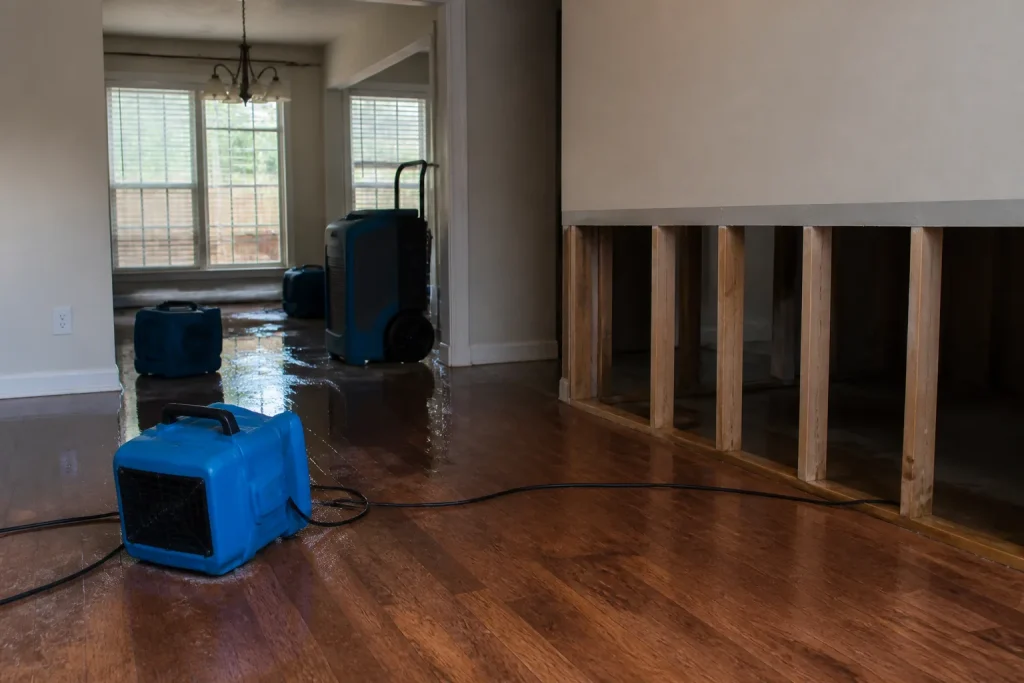
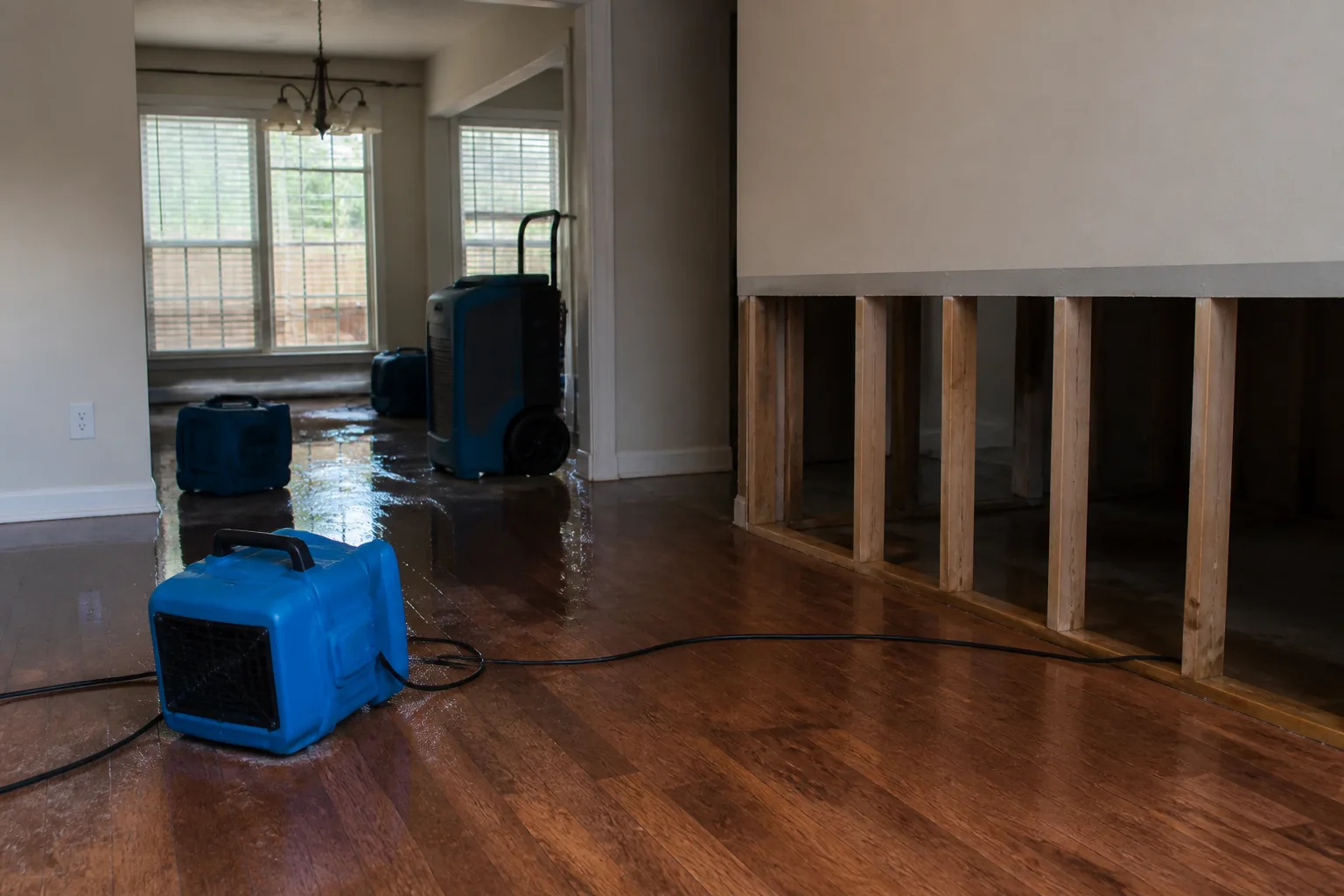
LGR dehumidifiers are the workhorses. LGR stands for low grain refrigerant. What that means for you is this: these units pull moisture out of the air, not just heat it up the way an old-school dehumidifier does. The 3500i and similar models are built for structural drying. They lower the humidity in the room so the water inside your drywall, subfloor, and framing gets pulled to the surface and evaporated.
Axial air movers are industrial fans, but the placement matters more than the fan. Water evaporates fastest when fast-moving air hits a wet surface. Contractors angle these at walls, under cabinets, and across finished floors to force evaporation. Set one in the center of an empty room and it just spins hot air. That’s the difference between a pro and a guy with a rented blower.
Thermal imaging cameras are the diagnostic tool. They show temperature differences behind walls and under floors, which reveal where water has migrated. In Jamaica’s older housing stock, water travels through plaster and lath in ways a moisture meter alone can’t map. A good tech uses both.
We run Dri-Eaz alongside Phoenix, XPOWER, B-Air, and Injectidry units. The brand gets attention, but honestly, the brand is less important than the training. We’ve seen homeowners in Jamaica hire a crew with top-shelf Dri-Eaz gear who never once checked a moisture reading after setup. The machines ran. The meters sat unused. The floor still buckled two months later.
What Numbers Should a Dri-Eaz Setup Be Hitting in a Jamaica Home?
The IICRC S500 is the industry standard for water damage restoration. It defines what “dry” actually means. Most homeowners in Jamaica never hear these numbers, and that’s the problem. Here’s what your contractor should be documenting from day one:
- Ambient humidity inside the affected room: Should trend downward every single day. A properly sized LGR should drop a room from 70% relative humidity to under 50% within 48 to 72 hours in most cases.
- Specific humidity (grains per pound): This is the number a trained tech tracks. The goal is to get the indoor air drier than the structural materials, which pulls moisture out of them. Anything above 55 grains per pound inside a drying chamber in Jamaica means the dehumidifier is undersized or the room isn’t sealed properly.
- Moisture content of wood framing and subfloor: Dry wood in the Northeast sits around 8 to 12% moisture content. Your contractor should be taking readings from framing, subfloor, and baseboards daily. If a board reads 14% or higher, drying isn’t done, no matter how the surface feels.
- Dry standard documentation: Before any crew picks up equipment, the log should show that all affected materials have returned to within 2 to 4 percentage points of an unaffected baseline area in your home. That baseline is established on day one.
If your contractor can’t show you these numbers, the Dri-Eaz machine on your floor is theater. It’s moving air and looking busy. The log is the proof of work, not the equipment.
Why Jamaica’s Attached Housing Changes Everything
Jamaica is dense. Semi-detached brick rowhouses sit wall-to-wall along blocks off Jamaica Avenue, Hillside, and Sutphin. Attached two-family homes share a common wall with a neighbor. When water enters one side, it migrates through shared structural members. That’s not dramatic language. It’s physics.
Moisture migration through a shared wall, a party wall, or a common floor system is the single biggest reason water damage jobs in Jamaica fail quietly. A contractor sets a Dri-Eaz LGR and a few air movers in the room where the pipe broke. The visible area dries. But the water that wicked into the neighbor’s side of the wall cavity, or into the floor joists shared between two units of a two-family, never got addressed.
Two months later the homeowner smells mildew. The neighbor’s wall is staining. The floor is soft at the threshold. The contractor is long gone and the equipment worked exactly as designed, in the wrong zone.
A proper setup in an attached Jamaica home includes checking the other side of every shared surface. That means thermal imaging on the neighboring unit’s side of the wall when access allows, baseline readings in rooms adjacent to the loss, and air mover placement designed to dry the actual wet materials, not just the space. It also means sealing the drying chamber correctly. An LGR in an open, unsealed attached home is pulling humidity from half the block through the party wall. It’ll run for days and hit nothing.
What a Legitimate Daily Moisture Log Looks Like
Here’s a real example, stripped down. If you’re in Jamaica and a contractor is drying your home, your log should read something like this, written or digital, updated every day the equipment is on site:
- Day 1: Baseline readings taken. Humidity 68%. Wood framing at 22% moisture content. Equipment placed. Extraction complete.
- Day 2: Humidity 55%. Framing at 17%. One air mover repositioned to dry the wall cavity behind the refrigerator.
- Day 3: Humidity 46%. Framing at 13%. Backside of baseboards reading elevated, injection drying added under the tile.
- Day 4: Humidity 41%. Framing at 10%. All materials within 3 points of baseline. Equipment pulled.
That’s a job done right. What you should never accept is a guy who drops three fans and a dehumidifier, comes back in four days, touches the wall with the back of his hand, and says “feels dry to me.” That’s not a moisture log. That’s a guess. And a guess is what turns a $2,000 dry-out into a $14,000 mold remediation and rebuild.
We’ve run jobs in Jamaica where the homeowner hired us after another company’s “dry” verdict, and the moisture meter still read 18% in the subfloor through the slab. The customer had a written report from the first contractor saying the job was complete. They had a wet floor and a five-figure problem. The Dri-Eaz machines the first crew used were fine. The process wasn’t.
The moisture log matters more than the brand on the equipment. This is also where Mold Remediation in Jamaica comes in. When drying is incomplete, mold follows within weeks. If you’re between a water event and a musty smell, a daily log is your best evidence of what happened and when.
How the 90-Day Done Right Promise Ties to the Log
Here’s where the paperwork becomes protection. Floodline Restoration Co. puts the Keystone Standard in writing on every job: if it’s not done right, we make it right. No arguing, no fine print battles. That promise is only possible because we document everything.
The 90-Day Done Right Promise works like this: we moisture-map the job from day one. We log daily readings until every affected material hits the dry standard. We hand you and your insurance carrier the log. If something we dried comes back within 90 days, and the log shows we were on site and we signed off, we return and fix it at no charge. The log is not a formality. It is the mechanism the promise runs on.
A contractor without a written log can’t offer a guarantee like that. They can say “call us if anything happens” but there’s no record of what they actually did. The guarantee is only as good as the evidence behind it. We’ve been doing this in Jamaica since 2010, and the reason a guarantee like ours isn’t standard practice in this industry is simple: most companies would rather argue than document.
This ties to every phase of restoration. If a water job in a Jamaica attached home isn’t dried correctly and mold follows, mold remediation is the next conversation. If it happened after a fire, the same documentation standard applies to Fire & Smoke Damage Restoration in Jamaica. The full-cycle approach starts at Water Damage Restoration in Jamaica and runs through rebuild. One crew, one log, one name accountable for all of it.
The Bottom Line
A Dri-Eaz machine is a tool, not a guarantee. What protects your Jamaica home is a contractor who knows the IICRC S500 standard, reads moisture daily, accounts for shared walls in attached housing, and puts every reading in writing. If the log shows proper numbers and problems recur, a written guarantee means the company returns and fixes it.
If you’re in Jamaica and dealing with water damage, or you suspect a previous dry-out wasn’t done right, call (518) 627-5878. Estimates are free, a live person answers, and we’ll walk you through what the numbers should look like before any equipment goes in.
Frequently Asked Questions
Most water damage dry-outs in Jamaica run between $1,800 and $4,500 depending on square footage, how long the water sat, and whether attached-wall migration is involved. Larger losses on finished basements or multi-floor jobs can run higher. Every quote from Floodline Restoration Co. includes a written scope, moisture map, and direct insurance billing. Call (518) 627-5878 for a free estimate.
Most structural drying jobs in Jamaica complete in three to five days. The variables are the age of the home, the type of flooring, and whether shared walls with a neighboring unit are involved. In attached brick rowhouses, drying often takes a day or two longer because of moisture migration through shared structural members. A good contractor will tell you the expected timeline after the first moisture readings, not before.
Daily readings are not overkill. They are the standard. The IICRC S500 requires that drying progress be documented regularly, and any contractor who resists showing you a written log is not following industry protocol. The log is also your only defense if you file an insurance claim and the carrier questions whether the damage was fully mitigated. If you wouldn’t accept a mechanic who declines to show you the work order, don’t accept a restoration crew without one.
In most cases, yes, if the damage is sudden and accidental. A burst pipe, a water heater failure, or a storm-related intrusion is typically covered. Gradual leaks that went unnoticed for months may be excluded, which is why documentation matters from the start. Floodline Restoration Co. bills your carrier directly and handles adjuster coordination. We provide photo documentation and the daily moisture log so the claim has a complete paper trail.
Call Floodline Restoration Co. at (518) 627-5878. A live dispatcher answers 24 hours a day, seven days a week. A certified crew will reach your Jamaica home the same day. Extraction starts on the first visit. You’ll get a written scope, direct insurance billing, and the 90-Day Done Right Promise in writing. Please note that Floodline Restoration Co. is a restoration contractor that uses Dri-Eaz equipment as part of its professional toolkit; Dri-Eaz is an independent equipment manufacturer and is not affiliated with this company.
Related services in Jamaica: water damage restoration, mold remediation, and fire and smoke restoration. Start at the Floodline Restoration Co. home page to see the full scope of what we handle.
Written by Curt Bowman, Owner at Floodline Restoration Co., serving Jamaica since 2010.
Need Damage Restoration Help?
Call Floodline Restoration Co. - licensed & insured, here with fast after-hours help in Jamaica.
(518) 627-5878